

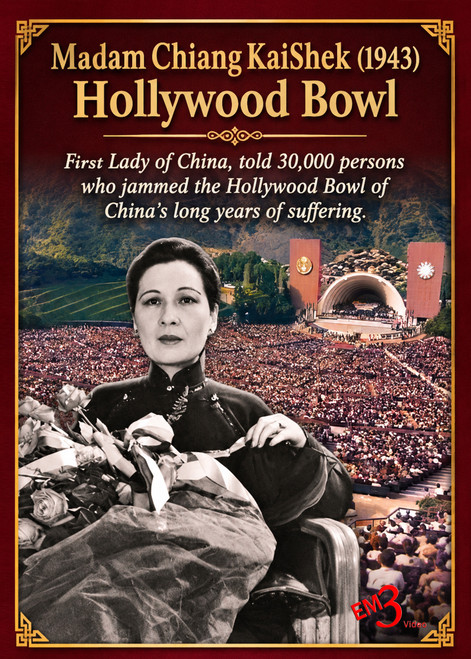
Madam Chiang Kai-Shek
(1943) Hollywood Bowl
Speaking in a low voice which broke intermittently with half-sobs, Madame Chiang Kai-shek, First Lady of China, told 30,000 persons who jammed the Hollywood Bowl of China's long years of suffering and warned defiantly that her people would not be robbed of an equitable peace. Her address in the Bowl on April 4 was her final public appearance on her tour of the United States. Photograph dated April 5, 1943.
To the tinseled home of make-believe last week went a realistic star of the first magnitude. Under the serene blue California skies Madame Chiang Kai-shek concluded her nationwide tour at a spectacular mass meeting held in the Hollywood Bowl (below). All Hollywood had contributed talent toward making this event a triumph of showmanship. But it was Madame Chiang's gracious charm, her indomitable spirit and her deeply stirring account of China's six-year war against Japanese aggression which made the dramatic climax of the afternoon.
Her fists clenched, emotion welling in her voice, China's First Lady reviewed the unforgettable, "ghastly memories" which have been burned into her mind and heart. She began her historical summary by picturing the insuperable obstacles which confronted her as secretary-general of the Chinese Air Force at the war's start in1937. Against the Japs' 5,000 fighting planes, China's air fleet was "pitifully and incredibly scanty - less than300."
As Madame Chiang spoke, her sympathetic audience listened in grave silence, tears springing to many eyes. No Hollywood-conceived pageant could match the awesome "nightmares" which Madame Chiang recreated with the magic of her words. She made these nightmares become for her audience a series of un forgettable vignettes of China's suffering and fortitude: the heartbreaking fight of the young Chinese air cadets who had un limited courage and almost no acceptable equipment; Madame's frequent trips to the front with the Generalissimo; the dreadful shambles at Soochow, where "stretcher bearers worked like wordless automatons trying to clear the station plat form of wounded while more and more wounded were unloaded;" the tight-lipped gallantry of soldiers and civilians while bearing the most excruciating pain; the intense loyalty of the people to their leaders despite gravest adversity; the sorrowful evacuation of once-beautiful Nanking, left devoured by flames; the barbaric, shameful rape of Nanking after the Japanese occupation when "the invaders plundered and stripped the crucified populace of all means of livelihood, molested our women and rounded up all able-bodied men, tied them together like animals, forced them to dig their own graves and finally kicked them in and buried them alive;" the organizing of the Chinese National Women's Advisory Council, which carried out a vigorous program of training girls and women for war activities; the ruthless Japanese bombing of boatloads of helpless war orphans; the incessant waves of enemy raids over Chungking which were so frequent that it was impossible to prepare food and finally exhaustion "permeated every nerve and bone so that it was preferable to risk being bombed to death than to get out of bed and seek safety."
Madame Chiang closed her speech with the pledge that China and the other United Nations would not permit "aggression to raise its satanic head and threaten man's greatest heritage: life, liberty and the pursuit of happiness for all peoples."
On the days preceding the mass meeting at the Bowl, the Missimo determinedly went through a staggering schedule although she is still suffering the effects of her recent serious illness. On Wednesday, March31, she arrived in Los Angeles, participated in a parade in her honor and gave a reception. The next day she greeted200 Hollywood film celebrities at a special tea. Friday she held a press conference, posed for photographers, and was guest of honor at a gala banquet in the Fiesta Room of the Ambassador Hotel which was attended by many of Los Angeles' famous citizens.
One of the most important but unpublicized conferences was a private meeting held in Madame Chiang's suite with a select group of studio heads. They discussed the motion picture as visual education in post-war China. And Madame Chiang urged that U.S. movies portray more accurately the real China.
Item: 1481-1 - ISBN: 0694536342194 - TRT: 70 minutes


